


Bullfrog Beer
 |
 |
 |
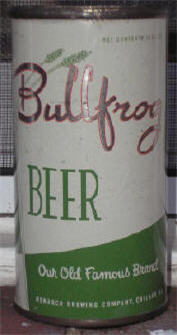
This month's COM is an old favorite, Bullfrog Beer!
Monarch Brewing
Monarch Brewing was founded in 1890 as the Josef Hladovec Brewing Company in Chicago. In 1892 it was purchased by I. Baumgartl and Charles Stein and renamed the Monarch Brewing Company. Monarch’s new owners already owned the Calumet Distillery and wanted to expand into brewing. At the time there was a beer price war in Chicago and Monarch announced that it would sell its beer for $4.00 a barrel, which was half of the $8.00 a barrel price set by an existing Chicago brewer’s association. The Brewer’s association tried to stem the fall of beer prices. They lowered their price to $6.00 a barrel, and then tried to pressure the city to ban the construction of any new breweries. Their efforts failed. Brewers began offering under the table rebates and kickbacks of up to a dollar a barrel. Meanwhile, brewers in neighboring cities discovered that they could ship beer into Chicago cheaply enough that they could compete with the local companies, so out-of-town beer began flowing into the city.
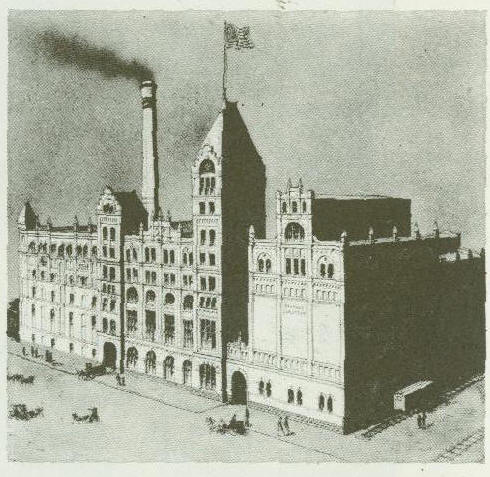 |
Chicago brewers found their market was flooded by over-production. The Chicago World’s Fair in 1893 provided some extra customers, but it only delayed the inevitable. A national depression had begun in 1893, the worst the U.S. suffered until 1929, and when the Fair closed, the full effects of the depression hit Chicago. Between falling prices and falling sale, the average profit fell from $1.22 a barrel to about fifteen cents. Then when the Spanish-American War started in 1898 Congress passed a war tax of a dollar a barrel, the cost of which was passed from the breweries to the saloonkeepers. The result was what one would expect, breweries failed and the survivors looked to ways to cut expenses. In 1898 Monarch became part of the United Breweries Company along with twelve other local breweries. Baumgartl became chairman of the board of the new combine, and Stein managed the Monarch branch. Monarch had a an annual capacity of 150,000 barrels a year and a bottling plant. |
Monarch Brewery (United Breweries), circa 1900.
The new United Brewery managed to hold off failure for a few years but consolidating and cutting expenses, but the parent company was still losing money and in 1903 it filed for bankruptcy and reorganization. The reorganized company survived until 1920, when Chicago finally went officially dry with the coming of national prohibition. In 1922 it was sold to a new ownership group from Chicago. The new owners, including Frank Schrader, Adolph Dirian, Joseph Hein and Henry Rose, would run the brewery through the rest of Prohibition and after repeal in 1933.
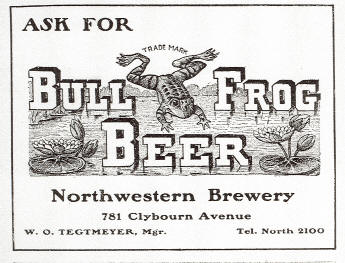 Bullfrog ad from 1916 or 1917. Northwestern Brewery was part of United Breweries and did not reopen after Prohibition.
Monarch kept in business during prohibition by making soda and near beer (i.e. cereal beverages). Their brands included Malt Tonic, Club Life Select, Monarch Brew and Bull Frog Beverage! Rumors circulated that it was aided by underworld figures looking for breweries to make real beer during the dry years, but such rumors were common for every Chicago brewery. It is certainly possible that Monarch’s near beer was made into “needle beer” once it left the brewery. Needle beer left the brewery as legal, de-alcoholized near beer. Then when it reached its destination, alcohol was injected into the keg through the bung. The end result wasn't as good-tasting as real beer, but at least it had some kick.
When prohibition ended in April 1933 numerous Chicago breweries scrambled to go back into business legally. Some breweries had kept in business during prohibition and so were geared up for repeal, while others had to dust off 12 years of cobwebs. Monarch had stumbled along and was ready when beer was legal at midnight April 7, but they only had a small inventory ready to sell. Their brew master was Adolph Dirian, who was also vice-president.
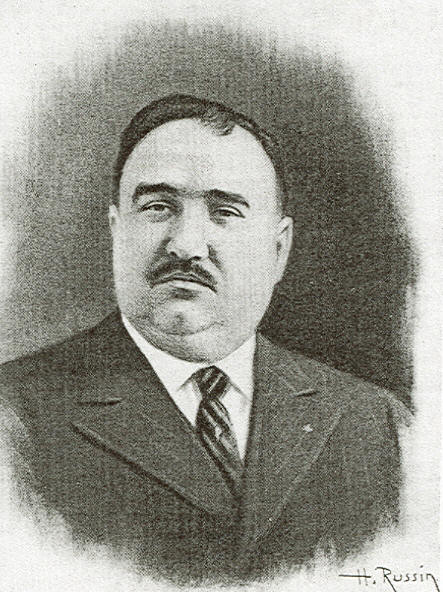 |
Dirian had been associated with Monarch before prohibition. A native of Bavaria he had arrived in the U.S. in 1890. He became an apprentice brewer at monarch in 1891 and worked in that position three years. He moved from job to job, learning his trade, and returned to Monarch in about 1900 as assistant brew master under George Grabner. In 1903 he enrolled in the Zymotechnic Institute in Chicago. After working in Pittsburgh he returned to Chicago, against working for United Breweries, but this time as the master brewer at Citizens Brewing. In 1912 he returned yet again to Monarch as master brewer and in 1922 was made Vice-President. Monarch’s president was Frank Schraeder. |
Adolph Dirian, circa 1937.
Post-prohibition Monarch Brewing made several beers. The “house brand” was Monarch. They also produced a premium beer called Encore, which was never canned, a malt beverage called Malvaz, Monarch Bock beer, Old Times, and Bullfrog, which was their “popularly priced” (i.e. cheap) beer. A 1956 Brewers Digest article mentions only four brands, Monarch, Encore, Augsburger Dark, and Malvaz. Why didn't they mention Bullfrog? I suspect it was an oversight by the article's author. But then, it also occurred to me that maybe they were not especially proud of Bullfrog, but that's probably over thinking a simple omission.
Bullfrog had been made by the Northwestern Brewing Company in Chicago from 1898-1920. None of Monarch’s brands were huge sellers. They didn’t start canning until after World War II and didn’t can Bullfrog until the late 1950s. Like every other Chicago brewery they had to battle for market share, especially with the big nationals and regional brewers in Milwaukee and St. Louis such as Budweiser, Schlitz, Pabst and Blatz. In 1956, according to Brewers Digest, there were about 100 brands of beer competing in Chicago. They came from local brewers, the nationals, regionals, and some that was "dumped" by out-of-state brewers at a discount.
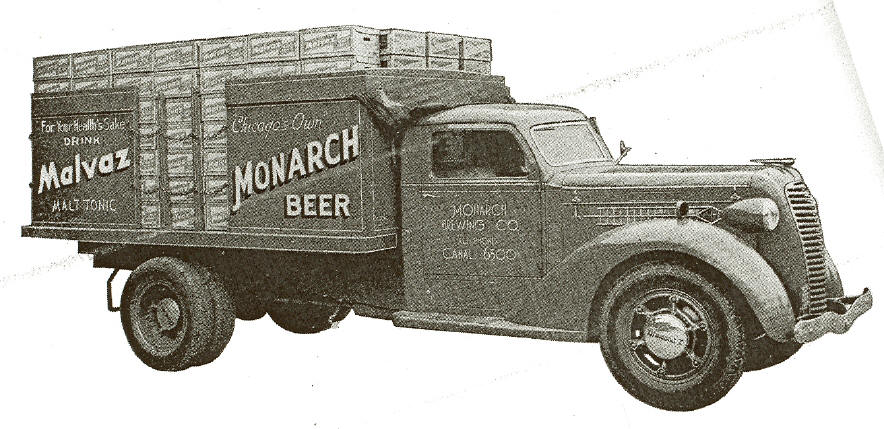 |
| Monarch beer delivery truck, circa 1939. |
Monarch tried different tactics in their marketing. They used local loyalties, asking people to “Be Loyal to their Local Community.” They also marketed Malvaz longer than most other breweries marketed such “Malt Tonics.” Most companies dropped such beers as soon as Prohibition ended, as if they had been tainted. Malvaz was advertised as perfect for the person who was “tired, had no appetite, were losing weight or couldn’t sleep.” A 1937 Malvaz ad continued “Summer months will be a pleasure, not an ordeal if you enjoy a keener appetite, increased weight and relief from jangled nerves.” Such “health” ads quickly fell out of favor after Prohibition. Certainly few beers advertised that they would help you gain weight!
Like many other breweries Monarch turned to television for advertising in the late 1940s and early 1950s. They sponsored a police show "Badge 714," and bought short (10 second!) ads on "Dragnet," "What's My Line," "The Burns and Allen Show," and "The Millionaire." The also sponsored a radio fishing show, "The Art Mercer Show" on Chicago station WBBM as part of a fishing promotion. Customers who mailed in six bottle labels or a handle from a six-pack carrier got a free fishing lure. They also gave out free rod and reels (of several types) to customers who wrote to the brewery explaining why they enjoyed fishing. The brewery gave away one rod and reel a week and over 13,000 lures. (FYI: I did a little digging and found Mercer's show listed in an Indiana newspaper as airing from 10:15-10:30 Wednesday night in 1956. I also found him mentioned as being on WBBM radio in 1967 so it looks as if his show lasted awhile.)
In the 1950s Monarch struggled along using far less than their capacity. They started canning sometime in the 1950s and used both conetops and flat tops, although the flats are more common and they only used conetops for their Monarch brand. They canned both Monarch and Bullfrog in 12 oz flats. According to a 1956 article they seem to have had one canning line (for flats) and two bottling lines, one for 7 and 12 oz bottles and one for quarts.
With one canning line they would have switched between Monarch and Bullfrog, the latter, as noted above, being their cheap brand. There are some interesting sites on the web from folks reminiscing about buying a case of Bullfrog as college students. One such author noted...
Wherever the brewery was located, the final product was consumed by me and my peers for only two reasons: First, it did have at least minimal alcoholic content and tasted vaguely like beer, though one which had been aged for only an hour or two in someone’s bladder before being bottled. Second, it was cheap, cheaper even than Coca Cola. Memory tells me that we once figured the price at 15 ½ cents a long neck bottle at a time when Coke sold for 25 cents a bottle. Bullfrog was even cheaper when purchased by the keg. Interestingly, there may not be a bar in the world that sells, or sold, Bullfrog beer either bottled or on tap. If there is one be assured that it will not be in business for long. However, for someone attending college on the GI Bill who was far from being a teetotaler it was the alcoholic drink of choice.
Unfortunately, the original article is only available in Google's cache now (see link under "Sources" below.)
Poor college students looking for a quick buzz wasn't enough of a market, however, and in late 1958 Monarch was sold to former Al Capone Lieutenant Joseph Fusco. Fusco already owned the Bohemian Brewing Company in Joliet. At the time of the sale to Fusco, Monarch has a brewing capacity of 275,000 barrels a year, but was only producing about 57,000 barrels. Fusco had acquired Van Merritt and Bohemian Club, popular Midwestern brands, during the late 1940s and early 1950s. Fusco changed Monarch's name to Van Merritt Brewing in 1958 and operated the Chicago facility under that name while closing the Joliet brewery. It was under the Van Merritt name that the old Monarch plant operated until closing in 1967. Like so many other Chicago breweries, they used names of convenience including Bohemian Brewing, House of Augsburg and Monarch.
Readers' MemoriesSince first posting this page in December 2005, I've gotten numerous emails from people who remember drinking Bullfrog beer. They all say the same thing, it was cheap beer to drink either after the good stuff was gone, or if you couldn't afford anything else! Thanks for the stories, and please keep them coming! email me! --Mark Here are some samples: ...it WAS cheap. 6 quarts for a dollar while other brands sold for 4 or 5 quarts for a dollar. My 70 year old mother in Milwaukee recalls Bullfrog's unofficial slogan--Bullfrog Beer-Drink a little, hop a little , and croak! ...it was cheap, 5 qts for a dollar (cheap drunk). They would say how awful it tasted until you got to the 2nd qt or 4th can then it tasted ok. Many apartment parties started with a case of Pabst, Blatz or Schlitz and after everyone was happy, the Bullfrog appeared! Nobody noticed! Reading your website reminded me of the advertising slogan painted on the side of a building on 53rd and Woodlawn in Chicago's Hyde Park neighborhood: "Bullfrog Beer - Never Goes Flat!" Though I never saw the beer for sale anywhere...I always wondered how "they" kept it from "going flat". I am from Milwaukee and I remember my Dad complaining about the bad tasting beer my cheapskate uncle ... served at a family “get-together” at his home. When we were driving home my Dad railed about the bad beer [my uncle] served. It was Bull Frog Beer and my Dad called it “panther piss”. I remember the incident vividly because my Mother hollered at him for cussing in front of the children while we and her were laughing. This happened about 1961 or ‘62. Thanks for recalling old memories….
|
Update:
Variation
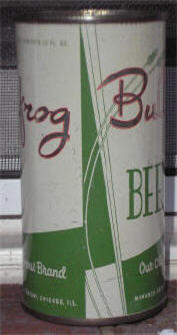
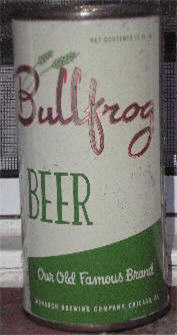
| There is one variation I know of for the Bullfrog can. The one pictured at the top simply reads "Monarch Brewing Company, Chicago Ill." at the bottom. There is another that says "Brewed and Filled By Monarch Brewing Company, Chicago, Ill." The latter one seems to be a bit scarcer but isn't rare as far as I know. Both are made by Continental Can, although they have different plant numbers. | 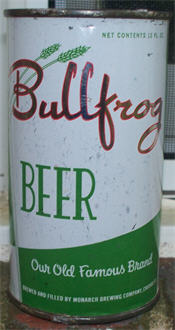 |
Brands Produced by Monarch (1933-1958)
(canned beer in italics)
Monarch
Bullfrog
Encore
Malvaz Tonic
Old Times
As always, corrections and additions are welcome! Please email me.
Brewery Name Changes
Joseph Hladovec Brewing Co. 1892-1895
Monarch Brewing Company 1892-1892
Monarch Brewing Co., aka Monarch Brewery (United Breweries) 1898-1909
Monarch Brewery (2419/2443 West 21st Street) 1909-1922
Monarch Beverage Co. 1923-1932
Monarch Brewing Company, Inc. 1932-1936
Monarch Brewing Company 1936-1958
Van Merritt Brewing Co. 1958-1967
(aka Bohemian Brewing, House of Augsburg, Monarch.)
Sources Used:
"A Chicago Story" Brewers Digest. (September 1956)
Brewery Age. (July 1937) 38.
"Credit, Where Credit is Due." Brewer's Technical Review. November 1937.
Duis, Perry R., The Saloon: Public Drinking in Chicago and Boston, 1880-1920.
Kay, Bob. "Chicago's Big 6 Prohibition Era Breweries"The Breweriana Collector. 147 (Fall 2009)
"List of Chicago Breweries" Modern Brewery. (September 15, 1933) 41-42.
"Men Whom You Know" Modern Brewer. (July 1936) 36-37.
"Monarch Chicago Brewery Sold to Bohemian of Juliet." Brewer's Journal. September 1958.
Oest, Uncle Ernie. "Chicago: Both Sides of Brewing and Drinking in Our Kind of Town" American Breweriana Journal. 85 (March-April 1997)
Pospychala, Phil & Joe McFarland. The Great Chicago Beer Cans.(libertyville, Il: Silver Fox, 1979)
Skilnik, Bob. The History of Beer and Brewing in Chicago, 1833-1978. (Pogo Press, 1999)
Summerfield, Dan. 'Toasting Bullfrog" (Google Cache copy)
Van Wieren, Dale P. American Breweries II. (West Point, PA.: East Coast Breweriana Association, 1995)
Western Brewer, 100 Years of Brewing. (Chicago: H.S. Rich & Co., 1903) 501.
Plus, thanks to Rich LaSusa for the valuable information he passed on to me as well as the 1916 advertisement.
