


Pace Pilsner: 1983-1984
 |
 |
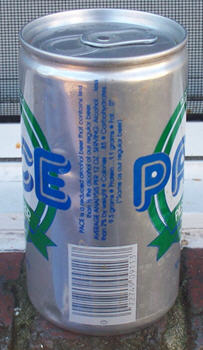 |
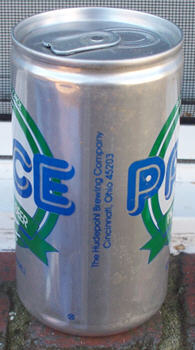
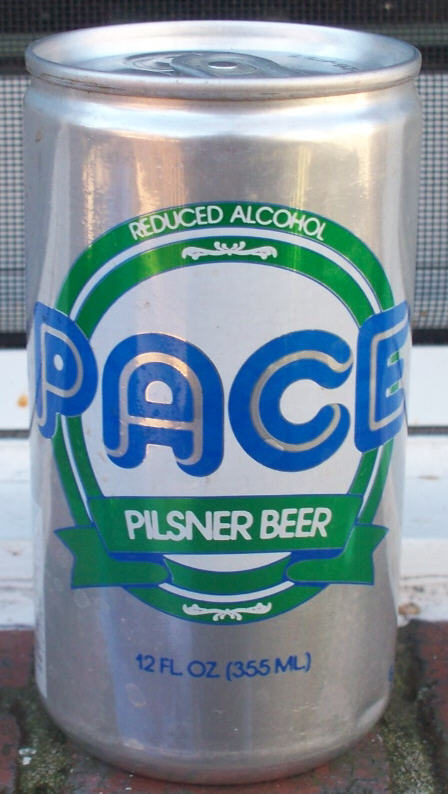
This month's can is part of a short-lived trend in American beer, the "low-alcohol" brew. It was sold from 1983-1985, mostly in Ohio.
Hudepohl in the Early 1980s
Pace was created by Cincinnati's Hudepohl Brewing in 1983. Hudepohl was a "tiny" brewery. Although it was ranked 13th of 42 American brewers, this was at a time when the top 10 sold almost 90% of all beer sold in the US. Brewing giant Anheuser-Busch sold about "150 times" more beer than Hudepohl, according to Hudepohl's General Manager, Bob Pohl. In order to survive, Hudepohl made a number of specialty beers to go along with their regular brand. (FYI, I've covered another Hudepohl can with my February 2008 COM and their Christian Moerlein brand as my May 2014 COM.)
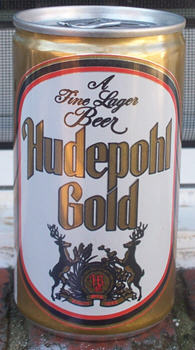 |
At the same time Hudepohl introduced a dark German-style lager, Hofbrau, another super-premium. In March 1982 Hudepohl released Ludwig Hudepohl Bock Beer using the brewery's original 19th century Bock recipe. In the Autumn of 1982 they released Hudepohl Special Oktoberfest Beer to coincide with Cincinnati's annual "Zinzinnati Oktoberfest." As they did with Christian Moerlein, the delivery of the first batch of this new beer was made via a traditional horse-drawn brewery wagon to a local historic restaurant. The new brands were doing well. More expensive than regular beers, they relied on using pre-prohibition beer recipes and local pride. And they were well-made, good beers. In early 1983 Hudepohl reformulated their Hudepohl brand slightly and launched Hudepohl Gold, also known as Hudy Gold. It was well received, so late in 1983 they made a more daring leap, trying to create a new type of beer, one that was low-alcohol. |
Pace is Introduced
In the early 1980s there was increased concern in the U.S. over alcohol abuse, especially drunk driving. MADD (Mothers Against Drunk Driving) was founded in 1980 and pressed state legislatures for stricter drunk driving laws. In March 1983 Ohio passed a stricter drunk driving law. In 1984 President Ronald Reagan signed the federal "Uniform Drinking Age Act" into law, which denied federal highway funds to states that did not raise their legal drinking age to 21.
Before 1984 Ohio had long had a two-tiered alcohol law. Beer with less than 3.2% alcohol was legal to buy at age 18. Beer with more than 3.2% could only be sold to those 21 or over. As a result some low-alcohol beers, so-called "near beers" had long been sold in Ohio. Hudepohl had sold near beer with slightly less than 3.2% alcohol in the 1930s and 1940s, but near beer had a poor reputation. I remember buying 3.2% Wiedemann Beer at Woody's Little Farm grocery store in West Carrollton when I was about 19 years old and wishing I was 21 so I could buy the "real beer." In addition, Hudepohl's management saw that some European countries, including Germany and Austria, had tapped into a market for reduced-alcohol beers, so such a product seemed feasible. Hudepohl General manager Pohl told a reporter that "the problem with near beer is they don't have a real beer taste. We came to the conclusion we couldn't brew near beer that tastes like beer." Instead, Pace was aimed at the then growing light beer market. Just as light beer was "real" beer with less calories, Pace would be "real" beer that happened to have less alcohol.
The brand was test marketed in Dayton, Ohio for six weeks starting in late August 1983. This was the first time Hudepohl had tested a new product outside of Cincinnati. (As a Dayton native I wonder if I should be proud or offended. They test market super-premiums in Cincy, but low alcohol in Dayton?) The brand was advertised as something you could drink a lot of on a hot day and not get drunk. The name itself was carefully chosen, it was a brand that allowed you to "pace yourself" which you can see in the beer's slogan, "The First Beer for Today's Pace."
The test was successful enough that Pace was distributed around the rest of Ohio. There was a problem, however, federal labeling laws did not allow for beers to be advertised as "Reduced Alcohol." Hudepohl got a waiver for their testing Pace in Ohio, but it remained a sticking point for selling the brand over a wide region.
Other breweries entered the low-alcohol market. Anheuser-Busch started selling LA beer in 1984. Detroit's Stroh Brewing made Schaefer LA, sparking a lawsuit with Anheuser-Busch over the "LA." There were other brands as well, including "Texas Select" which seems to still be on the market. LA, on the other hand, sank from sight and was replaced by O'Doul's.
Hudepohl-Schoenling
Pace didn't catch on as well as Hudepohl hoped, and seems to have been pulled off the market by 1986. Hudepohl continued making specialty beers, including their seasonal Bock. In 1985 Hudepohl celebrated their 100th Year in business. In 1986, however, they merged with Cincinnati's other surviving brewery, Schoenling. In 1987 all the brewing was shifted to the Schoenling plant. Hudepohl-Schoenling went through several different owners in the years since. They are now owned by the Christian Moerlein Brewing Company and their beers are made at several contract brewers around the country.
Sources Used
"Breweries on the Endangered List" UPI (October 17, 1983)
Holian, Timothy J. Over the Barrel: The Brewing History and Beer Culture of Cincinnati. Volume 2. Prohibition-2001. (Sudhaus, 2001)
Hudepohl Brewing Company. Wikipedia (accessed March 2010)
"Hudepohl Sets the Pace with new Low-Alcohol Beer" AP (January 1, 1984)
"New Low-Alcohol Beer Provides Half the Old High" (May 24, 1984)
"Pace' Lightens Alcohol Content" UPI (August 24, 1983)
"Soft Suds" Time (April 2, 1984)
