


Schlitz Conetop, circa 1935-1936
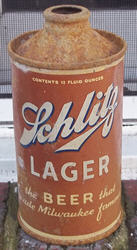 |
This month's can is one of the first conetops. Schlitz signed with Continental Can in August of 1935 to package their beer in Continental's conetop cans. American Can had begun selling their flat top cans in January 1935 starting with Krueger Brewing, and in July National Can had followed suit. Their cans were flat tops, which needed a special canning line to fill. Continental avoided this special need by designing the conetop, which could be filled by an existing bottling line with a few modifications. Flat top cans also needed a special opener, the "churchkey" to open, while conetops just needed a normal bottle opener to remove the cap.
Continental Can's Short-Lived Flat Bottom-Cones
Continental made conetops until about 1960 when the last brewery in the US to use them, Rice Lake in Wisconsin, finally switched to a flat top. Continental's first conetops had a few problems though. The initial model had a flat bottom and the ribs on the top were inverted, that is, they sank into the can. Supposedly the flat bottom can had problems with filling. Beer coming out of the filler spout into the can splashed up, resulting in air getting into the can which could spoil the beer. Making the bottom concave solved that problem.
The inverted ribs on the top allowed water, such as condensation on a cold can, to pool on the lid, which could tarnish the metal making the can look unsanitary. Continental marketed their cans as being more sanitary than the flat top because the cap covered the lip of the opening protecting it from dirt and germs and such. Having an unsanitary looking top would have negated that selling point. Using raised ribs rather than inverted on the lid fixed that problem. In 1937 the new style Continental conetop was being sold.
 |
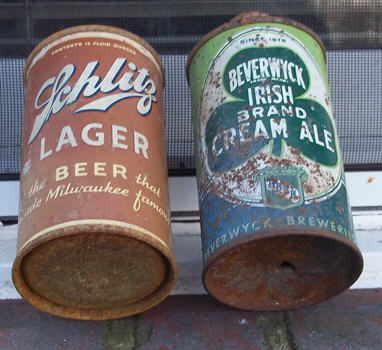 |
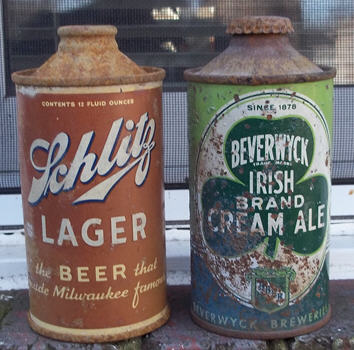
| Here are two conetops from Continental can. The Schlitz is the flat-bottom inverted rib type. It's very hard to tell the difference in the tops because they're both rusty, sorry. | Here you can see the flat bottom on the Schlitz and the concave bottom on the Beverwyck. Someone punched a hole in the bottom of the Beverwyck, probably when they were cleaning the can in acid. |
Crown Cork and Seal also entered the can market in 1936, and by 1937 was selling their own version of the conetop, known to collectors as a "j-spout." They also briefly used a flat bottom on their cans before switching to the concave bottom. See my July 2009 COM for a bit more on j-spouts. In 1940 CC&S abandoned the j-spout for a shorter two-piece conetop called the "crowntainer." These were in use until sometime in the mid 1950s.
Flat Bottomed/Inverted Rib Can List
This is a list of the brands that come in the flat-bottomed cone from 1935-1937. I marked Crown Cork & Seal's cans with "(CC&S)." There are multiple variations of many of these cans. The most common variation is a specific alcohol content listed on the label. Several midwestern states required a statement listing the alcohol content, such as "Contains Not More Than 4% Alcohol By Volume." I did not mark those variations here, but I did mark if there if the there are more than one labels for the same brand beyond just a different alcohol statement.
Berghoff Beer
Beverwyck Ale
Beverwyck Beer
Blatz Ale
Blatz Beer
Burger Beer
Century Lager
Duquesne Keg-O-Beer
Eblings White Head Ale (CC&S)
Ebling's Beer (CC&S)
El Rey Beer
Fitger's Beer
Fitzgerald Pale Ale (CC&S)
Fitzgerald Garryowen Ale (CC&S)
Fitzgerald Burgomaster Beer (CC&S)
Fitz Brew
Gluek's Beer
Goetz Country Club Beer
Grain Belt Beer
Hanley's Extra Pale Ale (CC&S)
Kato Gold Label Beer (2 different labels, plus variations)
Kato Lager Beer
Milwaukee Club Beer
National Ale
National Beer
Heileman's Old Style
Rainier Special Export Beer
Red Lion Ale
Schlitz Lager Beer
Schlitz Sunshine Vitamin D Beer
Thanks to Jim H. (AKA Conehead) for his help!
